Internal — for edits only Not the live site · leave notes with ✎ · Versy revises weekly (Mon 3am) notes: …
London · Nairobi · Delaware
Fund I · Frontline Enablement AgentBI, the first company, is being deployed in Kenya · Proving that public sector workforce products can be built to be investable
AgentBI
Nate — a public sector venture studio

Public service products
built to be investable

We turn grant-funded public sector delivery problems into investable software and service companies. Trillions flow into public services each year through products that are grant-dependent and invisible to private capital — we build them to stand on their own. The first, AgentBI, is being deployed in Kenya now.

The Thesis
Public sector problems are not inherently unbankable. They fail commercially because no one has built them with the right architecture — country-first in design, multi-country in scale, convertible from grant to investment.
The Model
Each Nate fund launches around a public sector theme. Each company in the fund solves a specific problem within that theme. Philanthropic capital de-risks early validation. Private capital enters when unit economics are proven.
The Proof
AgentBI — being deployed in Kenya. Rebuilding the infrastructure behind agricultural seed distribution. Proof of concept built through CGIAR fieldwork; a new Gates Foundation grant now funds the live build. Fee-generating from first deployment, multi-country from day one.
The proof of concept · Fund I — Frontline Enablement
Fund I
Frontline EnablementBuilding the data infrastructure for more effective training, hiring, and supervision of public sector workforces
Company 01 · In deployment
AgentBI
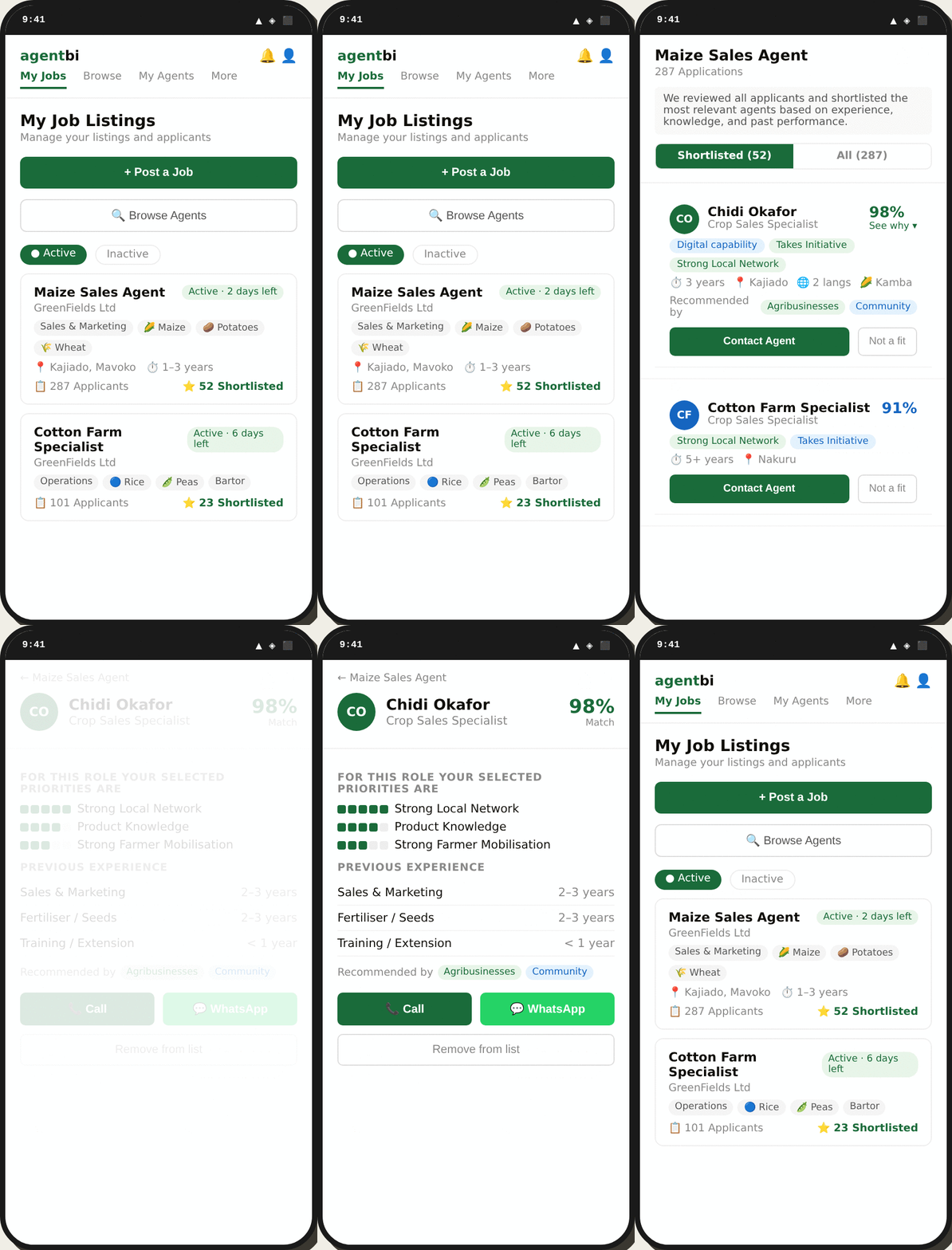
The business intelligence layer for public sector field workforces. Surfaces task completion, supervision patterns, incentive uptake, and retention signals as actionable insight for programme managers, governments, and funders. Adam Grunewald is the founder selected to lead it. The proof of concept was built through CGIAR seed systems work in Kenya; a new Gates Foundation grant is now funding the build of the live product.
StatusIn deployment
OriginGates-funded CGIAR fieldwork
GeographyKenya → Multi-country
View the demo →
Sourcing Ideas
Healthcare Frontline Enablement
Sourcing ideas for frontline enablement in healthcare — the same infrastructure thesis applied to community health workforces. Ideas are being generated and proto-tested under the theme now; the next spinout will be selected from this pipeline.
StatusSourcing ideas
MarketAfrica's 2M CHW commitment
Annual Public Spend$4.3B/year
Apply to be a co-founder or join the team prototyping companies →
The founding insight

A structure problem,
not a demand problem

Every country needs public infrastructure and services to reach its population. Hundreds of billions flow into these systems every year. These products are built for grant cycles, not for scale. They are built by governments for one country, by donors for one programme, by NGOs for one context. They are built to be funded, not to be investable.

"The market failure in public sector products is not that there is no market. It is that no one has built the products in a way that a private investor can enter."

Private conglomerates are already moving in — Veritas Capital, EQT, TA Associates, and PSG are deploying billions into govtech. NEOGOV was acquired for $3B+ in 2025 — the largest gov tech deal on record. The public sector is being commercialised. The question is whether products built for emerging markets and frontline workforces get built to participate in that transition — or get left behind.

We build every product from day one with dual architecture — grant-fundable today, investor-ready tomorrow.

The market
$9.8T
Public value GovTech is poised to unlock globally by 2034World Economic Forum, 2025
$20.5B
Gov tech deal volume in 2025 — a record year, up from the previous record of $13.1B — GovTech.com, 2026
2.7B
Deskless workers worldwide — roughly 80% of the global workforce — long underserved by software built for their context; public service delivery is among the least digitised — Emergence Capital
The Nate model — how we build differently
Thematic funds, not a portfolio scatter
Each fund launches around a single public sector theme. Many ideas are generated under it; the promising ones are proto-tested into companies with co-founders. Viable ones are seeded and spun out with pre-seed and seed capital and a founding team. The studio stays a co-founder, so companies share infrastructure, data, investors, and markets — and don't start from zero.
Dual architecture: grant-ready and investor-ready
Every company is designed with two funders in mind from day one — philanthropic capital that de-risks early validation, and private capital that enters once unit economics are proven. Built multi-country from the start, fee-generating from first deployment, and exit-legible from the first contract — grant-ready today, investor-ready tomorrow.
The conversion is the moat
A consulting firm can't convert a grant-funded programme into an investable company — it has no equity stake. A pure VC fund can't de-risk the early validation — it has no grant access. The studio sits at the intersection of both. Converting grant businesses into investable ones is the product, not a by-product.
The investment model

A different capital stack
for a different kind of product

Public sector products fail commercially for a predictable set of reasons: built for single-country deployment, locked to grant cycles, designed by programme logic not product logic, and exiting via government handover rather than M&A.

Why the current model fails

GovTech in developed markets has cracked the procurement model. But frontier markets remain grant-dependent by default. Procurement is fragmented, standards are non-existent, and products are built bespoke for each context. No one captures the value of having done it before.

Why Nate's model is different

The studio's capital structure matches the actual risk profile of each stage. Philanthropic capital covers ideation and early validation. Studio capital builds the product and finds PMF. Strategic corporates and growth PE enter when unit economics are proven. Each fund has a clear path from grant to investable — built into the product from day one.

Capital stack by stage
Stage 1 · Validation
Philanthropic & programme capital
Foundations, research networks, and multilateral development funders de-risk ideation and early field validation. Impact expectation, not return expectation.
Stage 2 · Product-Market Fit
Nate studio capital + grants
Nate's fund capital builds alongside the grant relationships. Managed service fees generate revenue from first deployment.
Stage 3 · Commercial Scale
Recurring revenue + strategic entry
Liquidity is built on repeatable revenue, not a speculative exit: the same product, sold on fees, to the many countries that need it. Strategic corporates and growth investors enter on top of proven demand.
Fund I · Frontline Enablement
In formation
AgentBI's live build is newly grant-funded; the fund vehicle is being structured alongside it. Enquiries —hello@petersonandgill.com
The fund pipeline — future themes

One studio,
many public sector problems

Fund I · Active
Frontline Enablement
Training, hiring, supervision, and performance infrastructure for public sector workforces. AgentBI in agriculture, with healthcare frontline enablement next in the theme. The foundational layer every other public sector product runs on top of.
Fund II · Pipeline
Climate Resilience
Decision infrastructure for climate-vulnerable governments and communities — flood risk, urban heat, agricultural adaptation, carbon credit verification. The data layer that makes climate policy actionable at the local level.
Fund III · Pipeline
Financial Inclusion Infrastructure
Market systems and payment infrastructure for excluded populations — women-led enterprises, rural traders, informal market actors. The bridge between development finance and private capital markets.
The investment arc

From grant-funded
to investor-ready

Phase 1 · Grant Entry
1
Enter with philanthropic capital, validate with field reality
Enter the problem space through existing programme relationships — foundations, research networks, multilaterals — with zero commercial risk. Build field evidence. Run real deployments. Most attempts die here because the product was built for the report, not for the user.
Phase 2 · Product Architecture
2
Build with dual architecture — not a pivot, a design choice
Every product the studio builds is architected for two futures simultaneously: continued grant funding for the programme logic, and private investment for the product logic. Multi-country by design, fee-generating from first deployment, exit-legible from the first contract.
Phase 3 · Commercial Scale
3
Recurring revenue and multi-country demand create liquidity
Liquidity comes from the commercial paths, not from a speculative exit. Once a company shows repeatable fee revenue and the same product deploying across many countries, private capital has a legible entry point — strategics as investors, acquirers, or distribution partners; growth capital for scale.
The team

Operators from inside
the systems we're commercialising

Co-founder
Nathanial (Nate) Peterson, PhD
Behavioural scientist and venture builder working at the intersection of agricultural markets, frontline delivery systems, and investable public sector infrastructure. Senior Scientist at the Alliance of Bioversity International & CIAT (CGIAR), managing foundation-funded programmes and CGIAR's Food Systems Accelerator. Founder of Burgeon Strategy, advising social enterprises on the pathway from philanthropy to venture and private capital. Formerly VP Partnerships at the Busara Center for Behavioral Economics and Regional Behavioural Specialist for the UN FAO. PhD in Behavioral Decision Research, Carnegie Mellon.
Co-founder
Nishita Gill
Founder of Treemouse, a behavioural research and design studio that spent a decade helping early-stage startups and public institutions connect with the people they serve — building pathways to adoption across 30+ engagements in government, global health, and fintech, for clients including Meta, WHO, BCG, Bajaj Finserv, and Omidyar Network. She built and now leads the digital product capacity for HIV, TB, and Hepatitis at the Clinton Health Access Initiative, was founding Head of Design at Fi.Money — India’s first major neobank — and redesigned India’s national identity infrastructure (Aadhaar) with the Government of India, a product now accessible to 1.35 billion people.
Research Partners
Busara — Behavioural-science-backed research, RCTs
Treemouse — Design strategy and field research
Irrational Labs — Behavioural-science-backed strategy
CGIAR — World's largest agricultural research network
Advisors
Michael Campbell — Head of Mass General Pharmaceutical Programs
Chaning Jang — CSO, Irrational Labs
How it fits together
The company
Peterson & Gill LLC
The legal entity behind everything on this page.
The studio
Nate
The venture studio Peterson & Gill operates. It generates ideas, proto-tests them, and co-founds the companies that emerge.
The vehicles
Funds, by theme
Each fund backs the companies built under one public sector theme. Fund I is Frontline Enablement.
The companies
AgentBI, and next
Independent spinouts, each with its own founding team. The studio stays a co-founder.

Public sector products were built to survive on grants.
We're building them to stand on their own.

Enquire about Fund I → Build a company with us →